
FIFA U-20 World Cup
Post Mortem: U.S. U-20 falls to Morocco in another QF exit. A look at the cycle

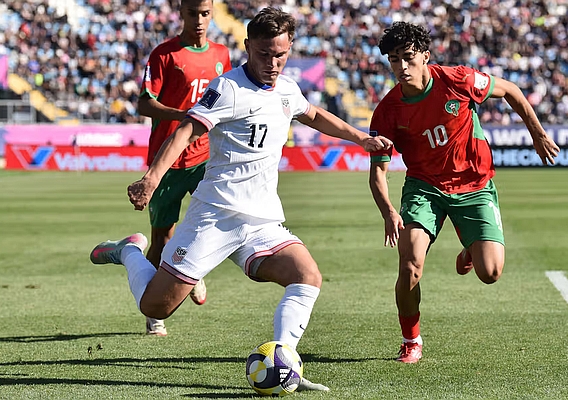
THE UNITED STATES U-20 national team saw its World Cup run end in the quarterfinals after a 3-1 loss to Morocco. It was a tough end for the team that believed it had the potential to do more and be a threat to win it all. Instead, however, the team will end at the same round the last four U-20 World Cup teams were ultimately eliminated.
As was the case in every one of its games this tournament, U.S. team dominated possession, completed passes, touches in the attacking third, and shots. But the team also had the same problems as we have seen throughout this tournament – too few dangerous chances were created from the lopsided possession, struggles in breaking down the low block, occasional sloppy transitional defending.
The problem in this game is that Morocco’s strength as a team was a perfect match to exploit the U.S. team’s weaknesses. Morocco was fast and ruthless in transition and was unbothered by the U.S. team’s possession. Defensively, Morocco was disciplined and patient in winning the ball back.
The U.S. team equalized right before the half when Nolan Norris drew a penalty on a long ball into the box. Cole Campbell, who had a tough tournament after he was expected to be the U.S. team’s best offensive player, buried the penalty.
Our #U20MNT's #U20WC comes to an end. pic.twitter.com/9uGEXUlmup
— U.S. Soccer YNT (@USYNT) October 12, 2025
But in the second half, it was more of the same as Morocco scored twice mistakes from the U.S. team – a Joshua Wynder own goal and a miscommunication in the back in stoppage time that put the game out of reach.
Here are some thoughts on it all.
Quarterfinal futility
The U.S. team now has an 0-5 record in the last five U-20 World Cups. In 2007 and 2003, the team was also bounced out in the quarterfinals making the team 0-7 in its last seven attempts to make the semifinal.
The quarterfinal is a tough stage because all the teams are good at this round and all the teams have a momentum edge. When you lose, it’s to a team that finishes at worst in the semifinal.
It’s frustrating for fans to see a team stuck at this level, for so long.
Putting it all together
When measuring this U.S. team against previous U.S. U-20 teams, it is the same but different. This U.S. team had different strengths and different weaknesses. But it was similar in that it was an incomplete team.
There were not enough scoring options up top. It marks the second straight cycle without a viable No. 9 (although, it should be mentioned that Ricardo Pepi was eligible for the 2023 U-20 team but was with the full national team at that point). Instead, we had to see false No. 9 formations. Also, when the team’s top winger in Cole Campbell saw his form drop off in Chile, it made scoring exceptionally hard.
Against Morocco, head coach Marko Mitrovic elected to use Benjamin Cremaschi in that role but in doing so, it took one of the best hustlers out of the midfield. Cremaschi is known for his intelligent reading of the game on both sides of the ball but against Morocco, he was limited in his opportunities on defense.
In youth national team soccer, it’s tough to put together a balanced team as a coach typically draws from two birth years at the U-20 level and some years will lag at certain positions or in certain areas of the game.
For example, this 2017 U-20 team had the finishers up top with Josh Sargent and Jeremy Ebobisse that this 2025 team did not have. But that team in 2017 could not hold the ball in a way even close to this U-20 team could. The 2015 team, meanwhile, had excellent central defense and goalkeeping but lacked in size elsewhere.
The U.S. U-20 teams, in all, have not been well balanced as they could be. The weaknesses can’t be as weak.
Silver lining? Consistency
For those who want to see a silver lining with this U-20 cycle, there are plenty. Exiting in the quarterfinal is certainly not a bad place to exit. Also, if a youth national team can routinely go to the quarterfinal, there will be sufficient production of prospective who then move to the next level
There is a hypothetical example in comparing two programs. One program wins the U-20 World Cup one in five cycles, but in the other four cycles it comes up well short of the quarterfinal. The second program (the United State, in this case) goes to the quarterfinals each time. Which is the preferred?
The team that goes to the quarterfinals each time is better. Sure, winning the U-20 World Cup might set up a “Golden Generation” but consistent production is key so long as in every few cycles, there is a production of good players across each of the positions.
It’s frustrating to not have an excellent U-20 cycle but there should be solace in being consistently good.
It is also fair that the cycle should be measured in the games it played throughout the cycle, not just at the World Cup. In total, the U.S. team posted wins over England, Argentina, Uruguay, Chile, France (twice), South Korea, Mexico, Colombia, Morocco, and Italy. Those wins and games were also reflective of the quality of these players and this group as a whole.
Who stood out?
Every U.S. U-20 team that makes a run in the knockouts has players who stood out and helped get them to this point. This team is no exception. Here are the team’s top performers who used this tournament to boost their stock and who we can expect more from in the future.
Benja Cremaschi: The midfielder from Florida was a solid leader of this group where he scored five goals and added three assists. He was a good captain and his effort was never in question. Now on loan at Parma in Italy, Cremaschi is a player to watch moving forward for both club and country.
Frankie Westfield: The Philadelphia Union right back had an excellent tournament where he was effective both in defense and in getting forward. He didn’t have an off game in the tournament. He’s been a breakout player in 2025 among this group and is closing in on a 2000 minute season with the Philadelphia Union. He now has a Supporters’ Shield to go along with U-20 accomplishments. Next up will be the MLS playoffs
Brooklyn Raines: The Houston Dynamo midfielder was one of the team’s biggest contributors to its possession advantage in each of its games. His passing and skill on the ball was impressive.
Niko Tsakiris: The San Jose playmaker has not played as much as he would have liked this season for the San Jose Earthquakes, but this tournament was evidence that Tsakiris is one of the best playmakers of this age group. Despite his lack of minutes, Tsakiris has played well for the U-20 team all cycle and could still attract enticing offers this winter.
Zavier Gozo: The Real Salt Lake attacker was one of the youngest players on this U-20 team and he is eligible for the team next cycle. He made some big strides this year for both club and country. It will be interesting if he can take it to another level with RSL next season. For him, it is also about locking down a consistent position.
Next up, the 2026 Olympics
This U.S. U-20 team is unusual because it is not the end of their development path with U.S. Soccer. This core group will now move on to form the U.S. U-23 Olympic team for the 2028 Olympics in Los Angeles. For the first time 32 years, the United States will not have to qualify for the event by virtue of being the hose.
That U-23 team will be led by the two oldest birth years of 2005 and 2006. Yes, some of the players on the current U-17 team and the 2027 U-20 team will also make up part of the Olympic squad. But it will be a minority. Most of that 18-player roster will come from players of this U-20 pool.
Even in defeat, there’s progress.
— U.S. Soccer YNT (@USYNT) October 12, 2025
Every match is a step forward in The U.S. Way. pic.twitter.com/5jRWp3ngW6
It should be a fun team too. This group will bring a lot of chemistry. Plus, there will be three overage players on that team who can address the weaknesses of this group. On top of that, if the USMNT is not involved in the Copa America that summer, then there is a high degree of likelihood that the overage players will be top USMNT players.
Combined with those games being on home soil, there should be every expectation that that team will be good. Hopefully U.S. Soccer has some plans to start having U-23 camps in 2026 to allow this team to stick together for that.